- Teacher: Eric Lemmon

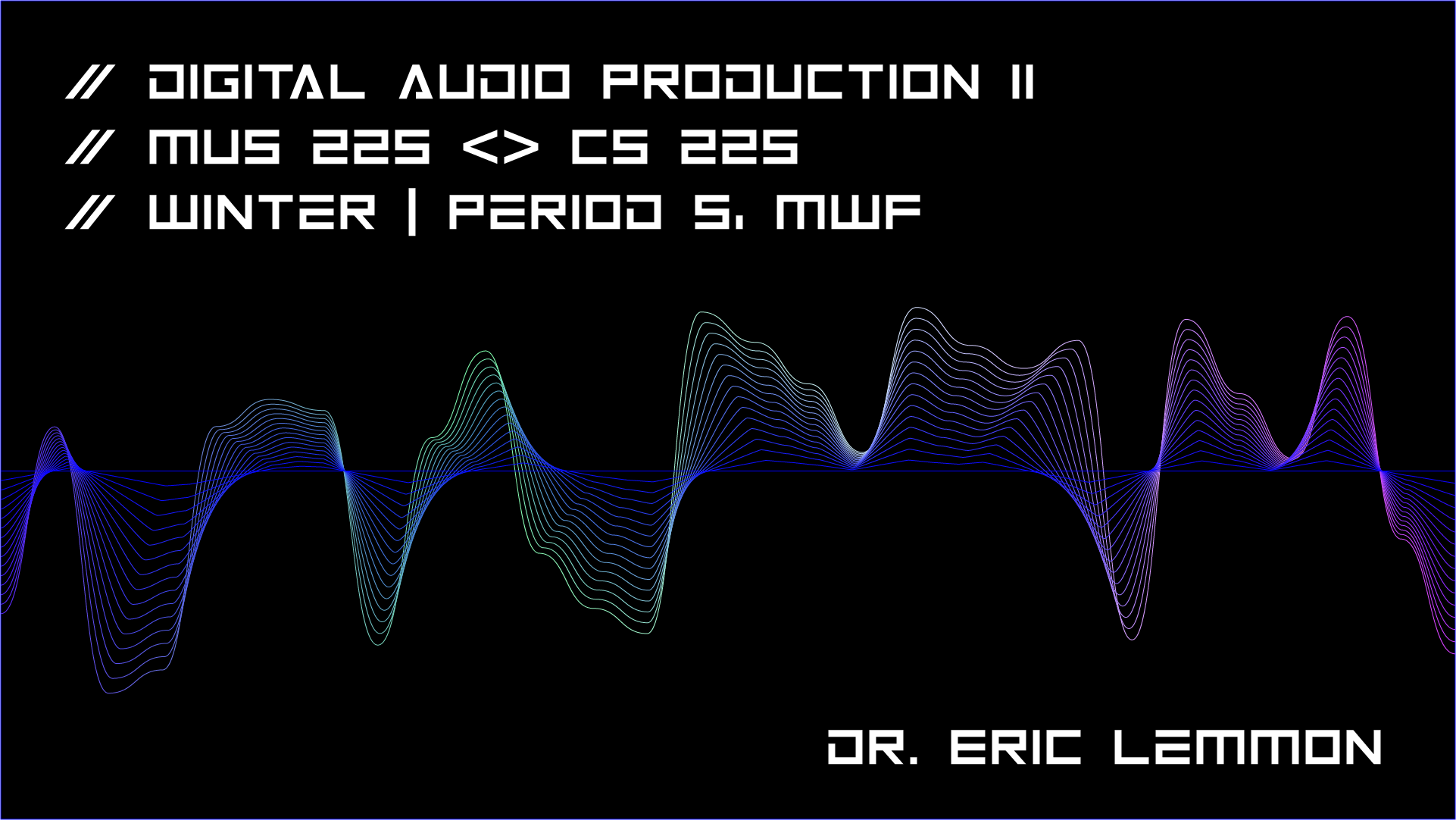
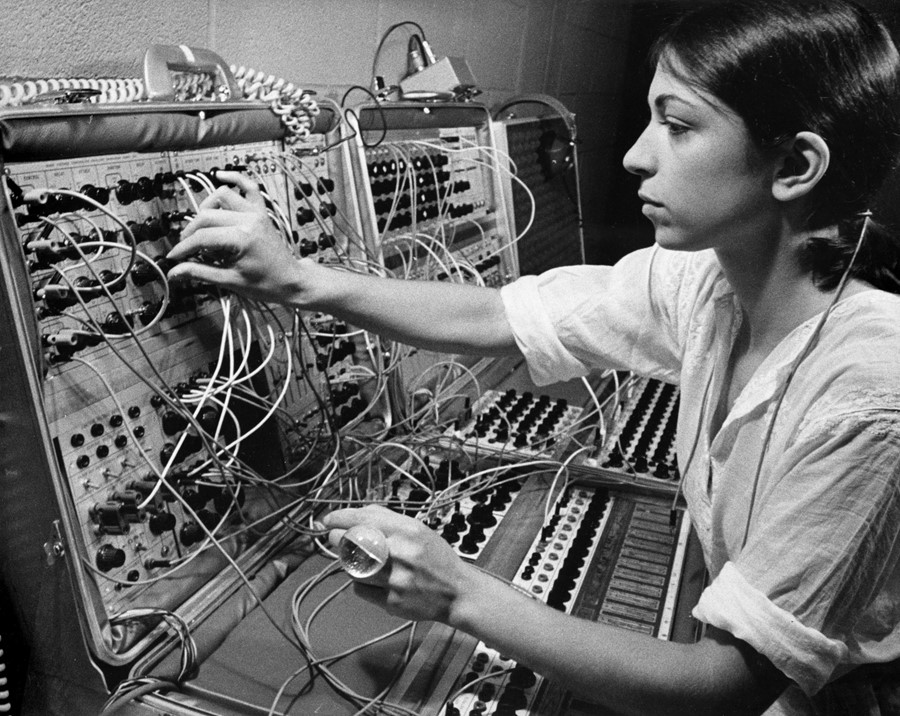
This course continues the themes and content from Digital Audio Production I, where students explored society’s digital reality through the creative, productive, and distributive processes of sound and music. As such, this course advances students’ technical knowledge by diving deeper into digital audio production through modular synthesis, advanced mixing projects, creative use of analog technologies blended with digital audio, computer music programming, as well as the theory and techniques of sound synthesis. In doing so, students will explore interactive and reactive creativity by deploying new and old technologies in unusual or critically relevant ways for musical composition.

The transformation of sound into digital data has profoundly affected the creation, production and distribution of music. With the vast majority of music now mediated by some form of digitization, it has shaped even our most basic modes of listening. This course grapples with the implications of this technology, its history, and its broad range of uses and tools. In doing so, students will utilize the Knox Electronic Music Studio to explore the foundational techniques of audio production, synthesis, sampling, podcasting, film scoring, and interactive software development.


A study of discrete mathematical structures. Logic and proof, set theory, relations and functions, ideas of order and equivalence, and graphs
The prerequisites are MATH 151, or CS 141 together with MATH 131 (or similar).

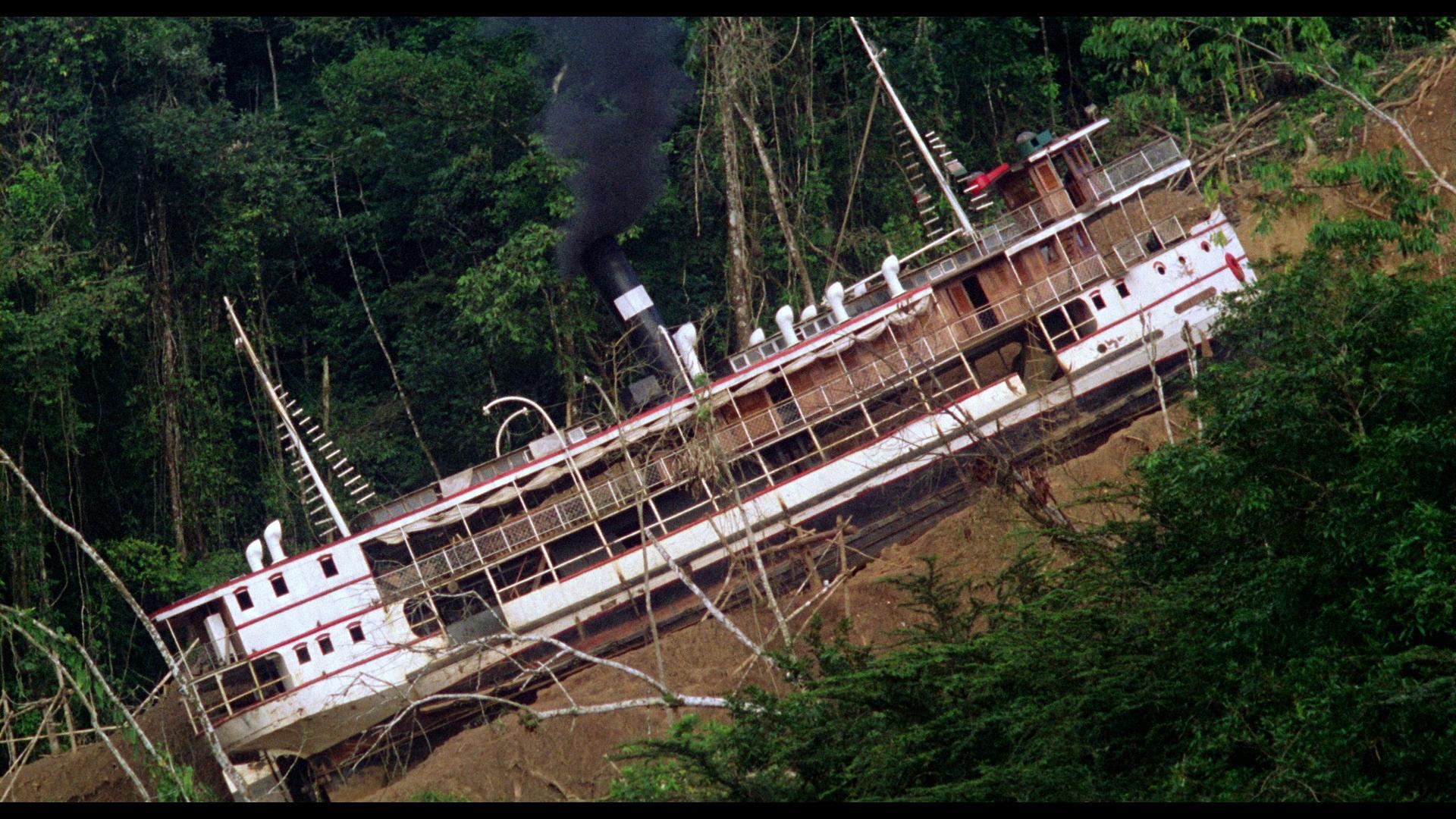
What makes a representation truthful? What, if any, differences are there between representing an event and representing a form of life? What criteria should we use to determine the fidelity of representations? Is truth best thought of as a correspondence between a representation and reality? What norms govern activities involving truth-telling? Above all, why is truth-telling so important to us? In this course, we examine these and related issues in the context of the history of documentary and non-fiction films. In so doing, we investigate the particular problems the presence of the camera creates for documentary and non-fiction representations. By taking up a number of such films, we will investigate different standards used in depicting an event, telling a story, or representing a way of life. In addition to examining a number of films from documentary and non-fiction traditions, we will also look closely at a number of related philosophical and critical texts. We read texts by Michel Foucault, Friedrich Nietzsche, Gottlob Frege, Simon Blackburn, Judith Butler, bell hooks, Siegfried Kracauer and others. We watch films by Frederick Wiseman, the Maysles brothers, Jennie Livingston, Marlon Riggs, Orson Welles, Chris Marker, Agnes Varda, Barbara Koppel, Robert Flaherty, and others.

This course will introduce the three major philosophical systems of East Asian thought: Confucianism, Daoism, and Buddhism through their canonical texts. This historical approach will be supplemented by contemporary readings in each tradition. When taught as a component of the Japan Term, this course will pay special attention to the development of Japanese Buddhism, specifically Pure Land Buddhism (Amida Buddhism), Esoteric Buddhism (Shingon Buddhism) and Zen Buddhism (Soto and Rinzai).

This course will explore a range of literary and other cultural products in which the physical environment is figured as a means of self-expression, aesthetic response, and critical commentary. Key points of discussion include the symbolic structure and form of landscape in literature, (e.g., the green world of pastoral and wilderness); the connection between space, race and place; what we mean by the “environmental imagination”; the relationship between humans, non-humans and objects; and what we talk about when we talk about the Anthropocene.


Many of us are attracted to science because of the wonder of discovery and the (supposed) purity of the pursuit of knowledge. In this course we will wrestle with some of challenging questions that arise in the practice of science.
Ethics is centrally concerned with questions regarding relations with oneself and with others and, more generally, our ways of life together. In this course we will examine competing accounts of the self’s relation to itself and to others from the history of philosophy. What sorts of relations to self and others do these accounts call for? We will concern ourselves especially with the various roles played by justice, pleasure, utility, and the good in these philosophical accounts. We will devote ourselves to close readings of texts by Aristotle, Immanuel Kant, John Stuart Mill, Philippa Foot, Charles Mills, Cora Diamond, Elizabeth Anscombe, Ralph Waldo Emerson, and others.

Ethics is centrally concerned with questions regarding relations with oneself and with others and, more generally, our ways of life together. In this course we will examine competing accounts of the self’s relation to itself and to others from the history of philosophy. What sorts of relations to self and others do these accounts call for? We will concern ourselves especially with the various roles played by justice, pleasure, utility, and the good in these philosophical accounts. We will devote ourselves to close readings of texts by Aristotle, Immanuel Kant, John Stuart Mill, Philippa Foot, Charles Mills, Cora Diamond, Elizabeth Anscombe, Ralph Waldo Emerson, and others.

In this course, we examine some of the ethical challenges presented by business and describe a particular form of business practice, central to our thinking about ethics and business, one that we can generally identify as accounting. In doing so, we will first look at several theorists concerned to describe the structure of business, including the relations between labor and capital. What relations do we have to capital? What relations do we have to each other through exchange? Why do these relations call for accounting? Next, we will turn our attention to a number of texts from the history of ethics in order to trace different ways of thinking about relations of the self to self and others. In addition, we will examine the ways in which these ethical views differ as ways of accounting for one’s self and one’s productive activities. Finally, we will turn to a number of case studies from the history of business in order to explore the importance of various forms of accounting. Why are such accountings necessary? To whom are we accountable and why?

In this course, we examine some of the ethical challenges presented by business and describe a particular form of business practice, central to our thinking about ethics and business, one that we can generally identify as accounting. In doing so, we will first look at several theorists concerned to describe the structure of business, including the relations between labor and capital. What relations do we have to capital? What relations do we have to each other through exchange? Why do these relations call for accounting? Next, we will turn our attention to a number of texts from the history of ethics in order to trace different ways of thinking about relations of the self to self and others. In addition, we will examine the ways in which these ethical views differ as ways of accounting for one’s self and one’s productive activities. Finally, we will turn to a number of case studies from the history of business in order to explore the importance of various forms of accounting. Why are such accountings necessary? To whom are we accountable and why?

Ethics is centrally concerned with questions regarding relations with oneself and with others and, more generally, our ways of life together. In this course we will examine competing accounts of the self’s relation to itself and to others from the history of philosophy. What sorts of relations to self and others do these accounts call for? We will concern ourselves especially with the various roles played by justice, pleasure, utility, and the good in these philosophical accounts. We will devote ourselves to close readings of texts by Aristotle, Immanuel Kant, John Stuart Mill, Philippa Foot, Charles Mills, Cora Diamond, Elizabeth Anscombe, Ralph Waldo Emerson, and others.

Ethics is centrally concerned with questions regarding relations with oneself and with others and, more generally, our ways of life together. In this course we will examine competing accounts of the self’s relation to itself and to others from the history of philosophy. What sorts of relations to self and others do these accounts call for? We will concern ourselves especially with the various roles played by justice, pleasure, utility, and the good in these philosophical accounts. We will devote ourselves to close readings of texts by Aristotle, Immanuel Kant, John Stuart Mill, Philippa Foot, Charles Mills, Cora Diamond, Elizabeth Anscombe, Ralph Waldo Emerson, and others.